
1. Increase Organic Search Visibility
One of the primary reasons enterprises invest in SEO is to improve their visibility in search engine results.
Customers frequently use search engines to research products, services, brands, and solutions. If an enterprise’s relevant pages do not appear prominently for valuable searches, potential customers may discover competitors instead.
Enterprise SEO services can help organizations identify opportunities to improve visibility across different areas of their website.
For example, an enterprise may have individual pages for:
- Products
- Services
- Locations
- Industries
- Solutions
- Resources
- Blogs
- FAQs
Each section may target different search intents and keyword groups.
An enterprise SEO strategy can help ensure that important pages are properly optimized and discoverable.
Why Organic Visibility Matters
Organic search can provide a continuous source of website traffic when a website earns strong visibility for relevant queries.
Unlike advertising, where traffic generally depends on ongoing ad spend, organic search visibility can continue generating visits after content and technical improvements have been implemented. However, SEO requires ongoing maintenance because search algorithms, competitors, customer behavior, and websites themselves change over time.
For enterprises with large websites, maintaining search visibility requires a systematic approach.
2. Manage Complex Enterprise Websites
Large websites can contain thousands of pages, multiple templates, complicated navigation systems, and constantly changing content.
These factors can create SEO challenges that are less common on smaller websites.
For example, enterprises may encounter:
- Duplicate content
- Broken links
- Poor internal linking
- Crawlability problems
- Incorrect redirects
- Indexing issues
- Slow pages
- Conflicting canonical URLs
- Orphan pages
- Duplicate metadata
- Poor website architecture
Identifying and resolving these issues manually can be difficult when a website has a large number of URLs.
Professional enterprise SEO services can help organizations establish technical processes for identifying and addressing these problems at scale.
Technical SEO At Scale
Technical SEO is particularly important for enterprise websites because small structural problems can affect large groups of pages.
For example, an incorrect template setting could potentially affect hundreds or thousands of pages.
A structured technical SEO process can include regular website audits, crawl analysis, indexation monitoring, page-performance checks, redirect management, and technical recommendations for development teams.
This helps enterprises maintain a healthier search-friendly website as it grows.
3. Build Brand Authority and Trust
Search visibility is not only about generating website traffic. It can also contribute to how customers discover and interact with a brand.
Enterprises can use SEO and content marketing to demonstrate expertise in their industries.
For example, an enterprise in the technology sector could publish content covering:
- Industry trends
- Product guides
- Research
- Technical explanations
- Customer questions
- Best practices
- Case studies
High-quality content can help users find useful information while introducing them to the brand.
Creating Valuable Enterprise Content
Large organizations often have access to valuable knowledge from internal teams, subject-matter experts, researchers, product specialists, and customer-facing employees.
SEO can help turn that knowledge into useful content.
Instead of creating content solely around keywords, enterprises should focus on answering customer questions and addressing genuine search intent.
This can support both search visibility and the overall customer experience.
4. Generate Sustainable Traffic and Business Opportunities
Enterprises typically need reliable channels for attracting potential customers.
SEO can contribute to long-term organic traffic by helping relevant pages appear for searches connected to products, services, and customer problems.
For example, a B2B enterprise may create optimized content around searches related to:
- Business software
- Enterprise solutions
- Industry-specific services
- Product comparisons
- Implementation guides
- Business challenges
A customer might discover an educational article through Google, explore the company’s website, visit a product page, and eventually request a consultation or contact the sales team.
This creates a potential journey such as:
Search → Content → Website → Product/Service → Lead → Customer
The exact customer journey varies by business, but SEO can support multiple stages of the buying process.
SEO Can Support Different Business Goals
Enterprise SEO can contribute to objectives such as:
- Increasing organic traffic
- Improving product discovery
- Generating leads
- Supporting online sales
- Increasing brand visibility
- Supporting local discovery
- Improving content performance
The key is to connect SEO metrics with meaningful business outcomes rather than focusing only on rankings.
5. Gain a Competitive Advantage in Search
Large enterprises often operate in highly competitive markets where multiple companies target the same customers and search terms.
A strong SEO strategy can help enterprises identify gaps in their competitors’ content and search visibility.
Competitive SEO research can reveal:
- Keywords competitors rank for
- Content topics competitors cover
- Pages receiving organic visibility
- Potential content gaps
- Search opportunities
- Areas where the enterprise can provide more useful information
The objective should not be to copy competitors.
Instead, businesses can use competitive insights to identify opportunities for creating more comprehensive, relevant, and useful content.
Staying Competitive Requires Continuous SEO
SEO is not a one-time activity.
Competitors publish new content, websites change, search behavior evolves, and search engines continuously improve their systems.
Enterprise SEO services can provide ongoing monitoring and optimization to help organizations respond to these changes.
Key Components of Enterprise SEO Services
A comprehensive enterprise SEO strategy generally includes several areas.
Technical SEO
Technical SEO focuses on the technical foundation of a website, including crawlability, indexation, site architecture, redirects, page experience, and other technical factors.
Keyword Research
Keyword research helps enterprises understand what their target audiences search for and identify relevant opportunities across products, services, locations, and informational topics.
Content Optimization
Existing content can be reviewed and improved to better match search intent, provide useful information, and support business goals.
Internal Linking
Internal links help connect related pages and provide pathways for both users and search engines to discover relevant content.
For large websites, a strategic internal-linking system can be particularly useful.
Local SEO
Enterprises with multiple physical locations can use local SEO strategies to improve visibility for location-specific searches.
International SEO
Global organizations may need SEO strategies for multiple countries and languages. International SEO requires careful consideration of site structure, language, regional targeting, and localized content.
SEO Reporting and Analytics
Regular reporting helps organizations understand performance and identify opportunities for improvement.
How Enterprises Can Measure SEO Success
SEO performance should be measured using metrics that relate to business objectives.
Important metrics may include:
- Organic traffic
- Organic conversions
- Search visibility
- Keyword performance
- Click-through rate
- Indexed pages
- Leads generated
- Organic revenue
- Engagement metrics
- Landing-page performance
Enterprises should avoid evaluating SEO based on a single keyword or ranking position.
A broader view provides a better understanding of how organic search contributes to business performance.
Common Enterprise SEO Challenges
Large organizations may face several challenges when implementing SEO.
Multiple Stakeholders
Marketing, development, product, content, legal, and other departments may all influence website changes. Establishing clear SEO processes can help coordinate these teams.
Website Complexity
Large websites can make technical SEO issues difficult to identify and resolve.
Content Scale
Producing and maintaining high-quality content across hundreds or thousands of pages requires planning and governance.
Slow Implementation
Technical changes may require development resources and approval from multiple teams.
Inconsistent SEO Practices
Different teams may use different approaches to page titles, content, URLs, internal links, and other SEO elements.
An enterprise SEO framework can help establish consistent standards across the organization.
Conclusion
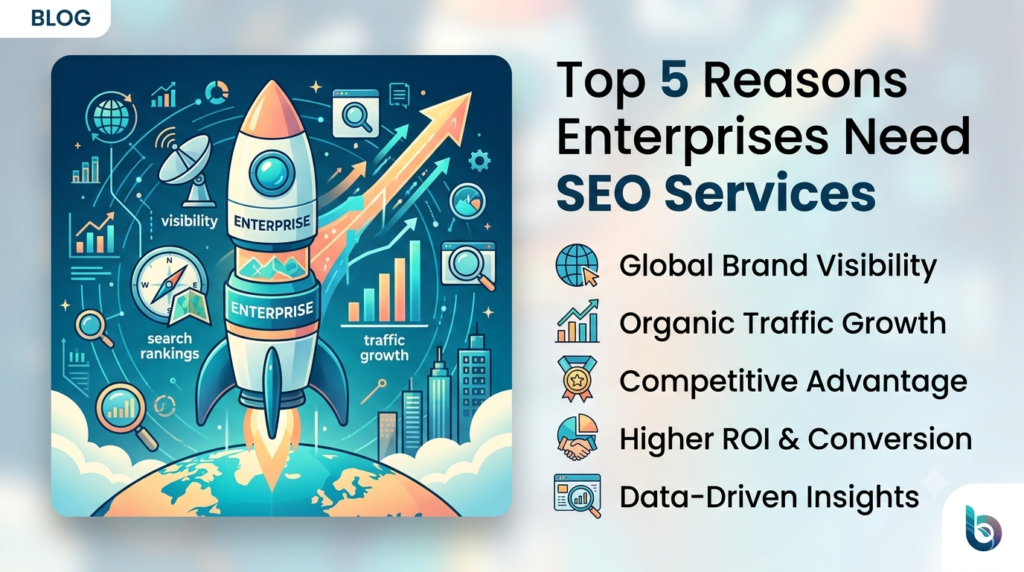
The top 5 reasons enterprises need SEO services are to increase organic search visibility, manage complex websites, build brand authority, generate sustainable traffic and business opportunities, and compete effectively in search.
Enterprise SEO goes beyond optimizing individual pages. It requires a scalable strategy that connects technical SEO, content, website architecture, keyword research, internal linking, analytics, and organizational processes.
For large organizations, investing in SEO can help create a stronger foundation for long-term online visibility. The most effective approach is to combine technical excellence with valuable content and a clear understanding of customer search intent.
As search behavior and digital competition continue to evolve, enterprises that treat SEO as an ongoing business strategy can better adapt their websites and content to changing customer needs.