
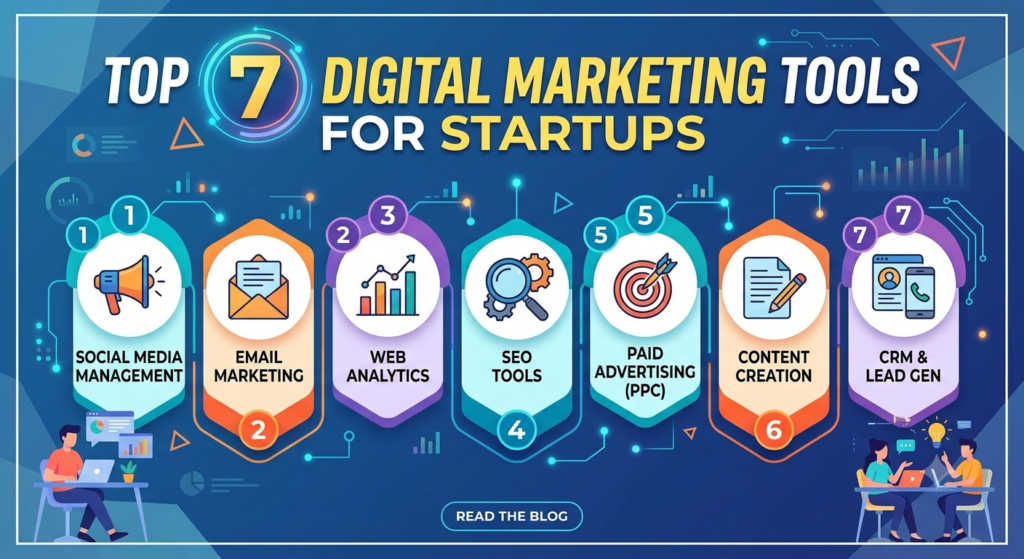
Starting a business is exciting, but building visibility, attracting customers, and managing marketing activities can be challenging for startups. With limited budgets and small teams, startups need efficient solutions that can help them save time, understand their audience, and improve marketing performance.
This is where digital marketing tools for startups become valuable. The right tools can help businesses manage search engine optimization (SEO), analyze website traffic, create content, manage social media, run advertising campaigns, and track leads.
Instead of using dozens of complicated platforms, startups can begin with a carefully selected set of tools that match their goals and budget.
In this article, we will explore the top 7 digital marketing tools for startups, their key uses, and how they can support business growth.
Why Do Startups Need Digital Marketing Tools?
Digital marketing involves several activities, including SEO, content creation, social media marketing, paid advertising, email marketing, analytics, and lead generation. Managing all these activities manually can consume significant time and resources.
Digital marketing tools can help startups:
- Save time on repetitive marketing tasks
- Understand website visitors and customer behavior
- Find valuable keywords
- Monitor SEO performance
- Manage social media content
- Create marketing graphics
- Track advertising campaigns
- Generate and nurture leads
- Measure marketing results
The important thing is not to use every available tool. Startups should choose tools based on their marketing objectives and customer journey.
Top 7 Digital Marketing Tools For Startups
1. Google Analytics – Track Website Performance
Google Analytics is one of the most widely used tools for understanding website and user activity.
For startups, having data about website visitors can help answer important questions such as:
- How many people visit the website?
- Where do visitors come from?
- Which pages receive the most traffic?
- How long do users engage with the website?
- Which channels generate conversions?
- What actions do visitors take?
With this information, startups can make more informed marketing decisions.
For example, if organic search is generating significant website traffic, a startup may decide to invest more resources into SEO and content marketing. If a particular landing page receives traffic but produces few leads, the company can test its content, design, or call-to-action.
Google Analytics can therefore become an important part of a startup digital marketing strategy.
2. Google Search Console – Improve SEO Performance
Google Search Console is another valuable tool for startups that want to increase their visibility in Google search results.
It provides information about how a website performs in organic search and can help website owners identify technical and search-related issues.
Startups can use Google Search Console to discover:
- Search queries bringing visitors to the website
- Pages appearing in search results
- Click-through rates
- Search impressions
- Indexing issues
- Website performance information
- Mobile usability and other search-related issues
For startups investing in SEO, this data can help identify content opportunities.
For instance, a startup may discover that one of its pages receives many impressions for a relevant keyword but has a relatively low click-through rate. The business could test a more relevant title and meta description.
Using Google Search Console alongside Google Analytics can provide a broader understanding of website performance.
3. Semrush – Research Keywords and Competitors
SEO is an important long-term strategy for many startups, but identifying the right keywords and understanding competitors can take considerable research.
Semrush is a popular digital marketing platform that provides tools for areas such as SEO, keyword research, competitor research, content, and online visibility.
Startups can use keyword research tools to identify search terms related to their products and services.
For example, a startup offering accounting software could research terms such as:
- Accounting software for small businesses
- Online accounting software
- Small business accounting tools
- Business accounting solutions
Keyword research can help marketers understand what potential customers are searching for and develop content around relevant topics.
Competitor research can also provide insights into keywords, content, and online visibility.
However, startups should avoid copying competitors. Instead, competitor research should be used to identify gaps and opportunities for creating more useful and original content.
4. Canva – Create Professional Marketing Content
Visual content plays an important role in digital marketing. Startups need graphics for social media posts, advertisements, presentations, blog images, brochures, and other marketing materials.
Canva makes it easier for businesses to create visual content without requiring advanced graphic design skills.
Startups can use it to create:
- Social media posts
- Blog graphics
- Infographics
- Presentations
- Digital advertisements
- Posters
- Business documents
- Marketing banners
One advantage of using a consistent design system is improved brand recognition. Startups can maintain consistent colors, fonts, logos, and visual elements across different marketing channels.
For small teams without a dedicated designer, a tool like Canva can simplify everyday content creation.
5. Mailchimp – Manage Email Marketing
Building an audience is only one part of digital marketing. Startups also need ways to communicate with potential and existing customers.
Email marketing can help businesses nurture relationships, share useful information, announce offers, and keep their audience engaged.
Mailchimp is a well-known email marketing platform that startups can use for activities such as:
- Creating email campaigns
- Managing subscriber lists
- Designing email templates
- Sending newsletters
- Automating certain communications
- Tracking email performance
For example, an e-commerce startup could collect email subscribers through its website and send product updates, educational content, and promotional campaigns.
A service-based startup could use email to share industry insights, case studies, and helpful resources with potential customers.
The key is to provide value instead of sending excessive promotional messages.
6. Meta Business Suite – Manage Social Media Marketing
Social media can be an effective channel for startups that want to build awareness and communicate with their audience.
Meta Business Suite helps businesses manage their presence across Facebook and Instagram from a centralized environment.
Startups can use social media management tools to:
- Create and schedule posts
- Manage messages
- Review content performance
- Monitor audience engagement
- Organize social media activities
For startups with limited marketing resources, planning social media content in advance can make the process more organized.
A simple social media content strategy could include:
Educational Content + Product Content + Customer Stories + Behind-the-Scenes Content + Promotional Content
The ideal content mix depends on the business, industry, and audience.
Social media should not only focus on selling. Educational and engaging content can help startups develop stronger relationships with their audience.
7. Google Ads – Generate Targeted Traffic
Organic marketing strategies such as SEO and content marketing can take time to build. Paid advertising can provide startups with another way to reach potential customers.
Google Ads allows businesses to advertise across Google’s advertising ecosystem and reach people based on relevant searches and other targeting options.
For example, a startup offering web development services may create campaigns around searches related to web development services.
Google Ads can help startups:
- Reach potential customers actively searching
- Drive traffic to specific landing pages
- Generate leads
- Promote products or services
- Test different marketing messages
- Measure advertising performance
However, simply running advertisements does not guarantee results.
Startups should pay attention to keyword selection, audience targeting, ad copy, landing page quality, conversion tracking, and campaign performance.
A well-structured campaign can help businesses understand which offers and messages resonate with their target audience.
How To Choose The Right Digital Marketing Tools For Your Startup
There are thousands of digital marketing platforms available, so choosing the right ones can seem overwhelming.
Start by identifying your business goals.
For SEO
Consider tools such as Google Search Console and Semrush to research keywords, monitor search visibility, and identify SEO opportunities.
For Website Analytics
Google Analytics can help you understand website traffic, engagement, and conversions.
For Content Creation
Canva can help your team create visual content for websites, social media, and advertising campaigns.
For Email Marketing
Email platforms such as Mailchimp can help businesses organize subscribers and communicate with their audience.
For Social Media
Meta Business Suite can help businesses manage Facebook and Instagram activities.
For Paid Advertising
Google Ads can help startups reach potential customers through targeted advertising campaigns.
The best digital marketing tools for startups are not necessarily the tools with the most features. They are the tools that solve your specific marketing problems and provide useful information for making business decisions.
Tips For Using Digital Marketing Tools Effectively
Having marketing tools is not enough. Startups should also create a process for using them effectively.
1. Define Your Goals
Decide whether your primary objective is brand awareness, website traffic, lead generation, sales, or customer retention.
2. Track Important Metrics
Do not focus on every available metric. Select key performance indicators that directly relate to your business goals.
3. Start Small
Avoid subscribing to numerous platforms at once. Start with essential tools and expand your technology stack as your marketing activities grow.
4. Connect Your Marketing Activities
Your website, SEO, advertising, social media, and email campaigns should work together rather than operate as completely separate activities.
5. Review Performance Regularly
Set aside time each month to analyze marketing data. Identify what is working, what needs improvement, and where your budget is generating meaningful results.
Final Thoughts
The right digital marketing tools for startups can make marketing more organized, measurable, and efficient. From analyzing website traffic with Google Analytics to improving SEO with Google Search Console and Semrush, startups have access to a wide range of platforms that can support different stages of their marketing journey.