
Starting a business is exciting, but getting noticed in a competitive market can be challenging. Startups often have limited budgets, small teams, and ambitious growth targets. This is where digital marketing for startups can make a significant difference.
Digital marketing allows startups to build brand awareness, reach their target audience, generate leads, and grow their business through measurable online strategies. Unlike traditional marketing, digital channels provide businesses with multiple ways to connect with potential customers based on their interests, location, online behavior, and search intent.
Whether you are launching a new product, building a service-based business, or creating an online brand, having a strong digital presence is becoming increasingly important.
In this article, we explore the top 7 reasons startups need digital marketing and how it can support sustainable business growth.
1. Builds Strong Brand Awareness
One of the biggest challenges for a startup is getting people to recognize its brand. Even if you have an excellent product or service, customers need to know that your business exists before they can consider buying from you.
Digital marketing helps startups build brand awareness across multiple online platforms. Search engines, social media, websites, email marketing, and online advertising can all help introduce your brand to potential customers.
For example, a startup can use:
- Search engine optimization (SEO)
- Social media marketing
- Content marketing
- Google Ads
- Email marketing
- Video marketing
Consistent branding across these channels can help your startup establish an identifiable online presence.
The more frequently potential customers encounter useful and relevant content from your brand, the more opportunities you have to build recognition and trust.
2. Helps Reach the Right Target Audience
Traditional advertising can sometimes make it difficult to reach a highly specific audience. Digital marketing provides startups with tools that can help them target potential customers according to relevant characteristics and online behaviors.
For example, a startup selling fitness products may want to reach people interested in fitness, healthy lifestyles, sports, or workout programs.
Through platforms such as search engines and social media, businesses can create campaigns designed around specific audiences and customer interests.
Targeted digital marketing can help startups focus their marketing resources on people who are more relevant to their products or services.
Understanding your target audience is also essential. Before creating campaigns, startups should identify:
- Who their ideal customer is
- What problems customers are trying to solve
- What products or services they need
- Which platforms they use
- What keywords they search for
- What factors influence their purchasing decisions
This information can help create more relevant marketing campaigns.
3. Generates Quality Leads and Customers
For most startups, attracting potential customers is an important part of growth. Digital marketing can help businesses generate leads through multiple channels.
A well-optimized website can attract visitors through search engines. Social media content can encourage users to interact with your brand. Paid advertising can bring targeted visitors to landing pages, while email marketing can nurture potential customers.
A typical startup lead-generation strategy may include:
SEO → Website Traffic → Landing Page → Lead Form → Follow-Up → Customer
For example, a startup offering digital marketing services could publish an article targeting the keyword “digital marketing services for startups.” Someone searching for that information may discover the article, visit the website, learn about the company’s services, and submit an inquiry.
This makes content and SEO valuable components of a long-term startup lead generation strategy.
4. Provides Cost-Effective Marketing Opportunities
Budget is one of the biggest concerns for many startups. Digital marketing offers different strategies and platforms that can be adjusted according to business objectives and available resources.
Instead of relying entirely on expensive traditional advertising, startups can combine organic and paid strategies.
Organic strategies include:
- SEO
- Blogging
- Social media content
- Email marketing
- Online communities
- Content marketing
Paid strategies can include:
- Google Ads
- Social media advertising
- Display advertising
- Remarketing campaigns
- Sponsored content
Startups can begin with a manageable budget, monitor performance, and make adjustments based on campaign data.
However, cost-effectiveness does not mean marketing should be done without planning. A clear strategy, relevant audience targeting, compelling content, and proper conversion tracking are important for making better use of a marketing budget.
5. Helps Startups Compete With Established Businesses
Established companies often have larger marketing budgets and stronger brand recognition. However, digital platforms provide startups with opportunities to compete for customer attention by focusing on specific markets and audiences.
A startup does not necessarily need to target everyone.
Instead, it can focus on a specific niche and create highly relevant content around its customers’ needs.
For example, a small software startup could target a specific group of businesses rather than competing directly with a large technology company across every possible market.
SEO, content marketing, social media, and targeted advertising can help startups build visibility within their chosen niche.
A focused digital marketing strategy can therefore help a startup communicate its unique value proposition and reach customers who are actively looking for relevant solutions.
6. Builds Customer Engagement and Trust
Customers increasingly research businesses online before making purchasing decisions. They may visit a company’s website, read reviews, check social media profiles, watch videos, or search for information about its products and services.
This makes online trust important for startups.
Digital marketing gives startups multiple opportunities to communicate with their audience and demonstrate expertise.
For example, businesses can publish:
- Educational blog posts
- Customer testimonials
- Product demonstrations
- Case studies
- Social media posts
- Helpful videos
- Frequently asked questions
- Industry insights
Regularly providing useful information can help customers understand your expertise and offerings.
Social media also provides an opportunity for two-way communication. Startups can respond to comments, answer questions, collect feedback, and communicate directly with customers.
Over time, these interactions can contribute to stronger customer relationships.
7. Provides Measurable and Trackable Results
Another major advantage of digital marketing is the ability to measure campaign performance.
Traditional marketing can make it difficult to determine exactly how many people interacted with an advertisement or how many customers were influenced by it. Digital marketing platforms can provide detailed performance information.
Startups can track metrics such as:
- Website traffic
- Search rankings
- Click-through rates
- Leads generated
- Conversion rates
- Cost per lead
- Engagement
- Ad performance
- Email open rates
- Customer acquisition metrics
For example, if a Google Ads campaign is generating clicks but very few leads, the startup can investigate its keywords, advertisement, landing page, or targeting.
Similarly, if a blog article is receiving significant organic traffic, the business can identify opportunities to improve the article and create related content.
This data-driven approach allows startups to continuously test, learn, and improve their marketing activities.
How Startups Can Build a Digital Marketing Strategy
Understanding the benefits of digital marketing is only the first step. Startups also need a practical strategy.
Here is a simple framework to get started.
Step 1: Define Your Marketing Goals
Set specific goals before launching campaigns.
Your goals might include:
- Increasing website traffic
- Generating leads
- Increasing online sales
- Building brand awareness
- Growing social media engagement
- Improving search visibility
Clear goals make it easier to measure progress.
Step 2: Identify Your Ideal Customers
Create a clear customer profile. Understand their problems, preferences, purchasing behavior, and online habits.
This information can guide your content, advertising, SEO, and social media strategies.
Step 3: Build an SEO-Friendly Website
Your website is often the foundation of your digital marketing strategy.
Make sure it is:
- Mobile-friendly
- Fast-loading
- Easy to navigate
- Secure
- Search-engine optimized
- Focused on user experience
- Equipped with clear calls to action
Each important service or product should have a dedicated page optimized for relevant search queries.
Step 4: Create Valuable Content
Content marketing can help startups attract users who are searching for information related to their products or services.
Create content that answers customer questions and solves real problems.
Examples include:
- How-to guides
- Industry articles
- Comparison posts
- Case studies
- Checklists
- Tutorials
- Frequently asked questions
Focus on providing genuine value rather than simply inserting keywords into articles.
Step 5: Track and Improve Performance
Use analytics and advertising data to understand what is working.
Review your performance regularly and identify:
What is generating traffic?
What is generating leads?
Which campaigns are producing conversions?
Which content attracts the right audience?
Use these insights to improve your strategy over time.
Common Digital Marketing Channels for Startups
Depending on the business model and target audience, startups can consider several digital marketing channels.
Search Engine Optimization (SEO)
SEO helps websites improve their visibility in search engine results and can support long-term organic traffic growth.
Google Ads
Google Ads can help startups reach people searching for products and services related to their business.
Social Media Marketing
Platforms such as Instagram, Facebook, LinkedIn, and other social networks can help startups build communities and engage with their audiences.
Content Marketing
Blogs, videos, guides, and educational resources can attract potential customers and demonstrate industry expertise.
Email Marketing
Email can help startups nurture leads, communicate with existing customers, and promote relevant products or services.
The right combination depends on your audience, industry, goals, resources, and customer journey.
Conclusion
Digital marketing has become an important growth tool for startups looking to establish an online presence and connect with potential customers. From building brand awareness and generating leads to engaging customers and measuring performance, digital channels provide startups with multiple opportunities to grow.
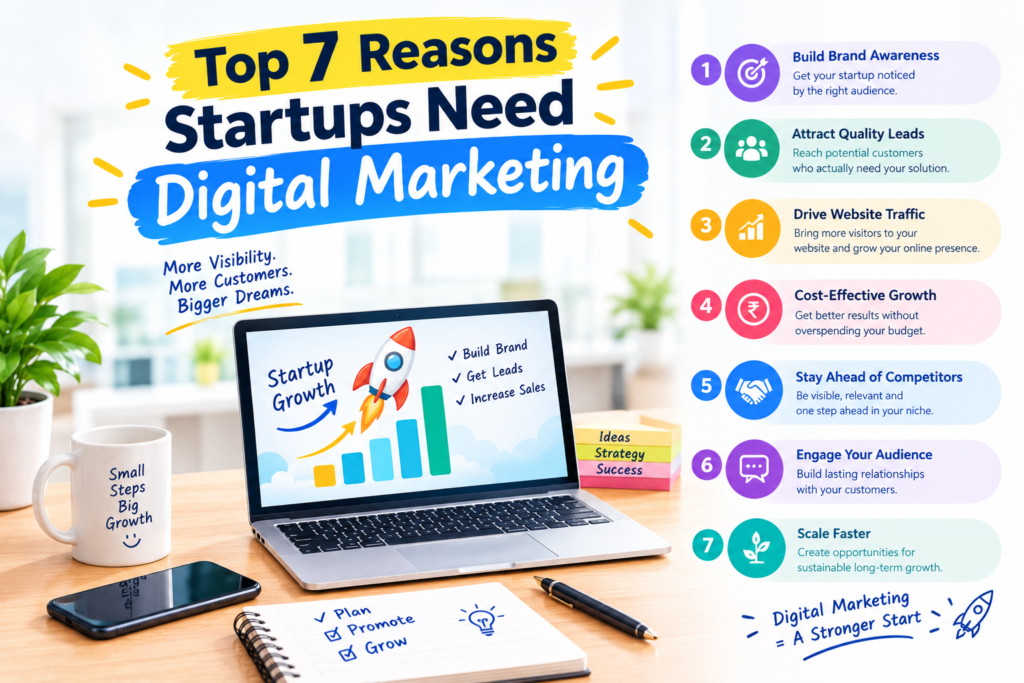
The top 7 reasons startups need digital marketing include building brand awareness, reaching the right audience, generating quality leads, creating cost-effective marketing opportunities, competing within a niche, building customer trust, and measuring results.
However, successful digital marketing is not about using every platform at once. Startups should focus on understanding their audience, setting clear goals, choosing relevant channels, creating valuable content, and continuously analyzing performance.
With a well-planned digital marketing strategy for startups, businesses can create a stronger online presence and build a foundation for sustainable growth.